Functionalism and Poverty: On the surface, poverty appears to be a dysfunction, however, according to Durkheim this is untrue stating instead that poverty or social inequality is necessary for the smooth functioning of society. This view on poverty can be better recognized by understanding the functionalist perspective on social stratification Apr 18, · The sociology of gender is one of the largest subfields within sociology and features theory and research that critically interrogates the social construction of gender, how gender interacts with other social forces in society, and how gender relates to social structure overall. Sociologists within this subfield study a wide range of topics with a variety of research methods, including things A functionalist approach is closely linked with a quantitativ e. and constrained by factors such as gender, ethnicity and social class. Income inequality and social coercion versus class
The Functionalist Perspective | Introduction to Sociology
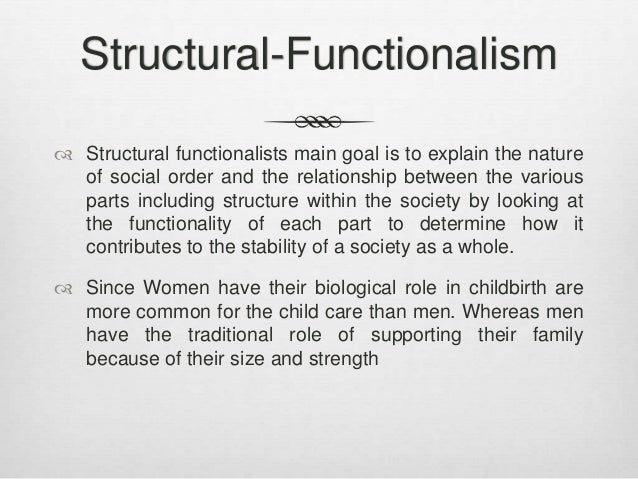
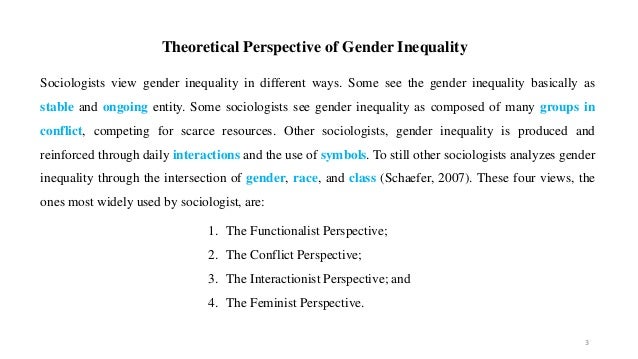
The functionalist perspective of gender roles suggests that gender roles exist to maximize social efficiency. The functionalist perspective sees society as a complex system whose parts work together to promote solidarity and stability. This approach looks at society through a macro-level orientation, which is a broad focus on the social structures that shape society as a whole and looks at both social structure and social functions. Functionalism addresses society as a whole in terms of the function of its constituent elements, namely: normscustoms, traditionsand institutions.
This theory suggests that gender inequalities exist as an efficient way to create a division of labor, or as a social system in which particular segments are clearly responsible for certain, respective acts of labor.
The division of labor works to maximize resources and efficiency. A structural-functionalist view of gender inequality applies the division of labor to view predefined gender roles as complementary: women take care of the home while men provide functionalist approach to gender inequality the family, functionalist approach to gender inequality. Thus gender, like other social institutionscontributes to the stability of society as a whole.
In sociological researchfunctional prerequisites are the basic needs food, shelter, clothing, and money that an individual requires to live above the poverty line. Functional prerequisites may also refer to the factors that allow a society to maintain social order.
According to structural functionalists, gender serves to maintain social order by providing and ensuring the stability of such functional prerequisites. This view has been criticized for reifying, rather than reflecting, gender roles. While gender roles, according to the functionalist perspective, are beneficial in that they contribute to stable social relations, many argue that gender roles are discriminatory and should not be upheld.
The feminist movement, which was on the rise at the same time that functionalism began to declinetakes the position that functionalism neglects the suppression of women within the family structure. A Female Indian Construction While functionalist approach to gender inequality structural-functionalist perspective argues that gender inequalities exist as a form of the division of labor, the photograph above clearly illustrates that women need not be restricted to certain activities.
Source: Boundless. Retrieved 27 Feb. Skip to main content. Gender Stratification and Inequality. Search for:. The Functionalist Perspective Brief The functionalist perspective of gender roles suggests that gender roles exist to maximize social efficiency, functionalist approach to gender inequality. Learning Objectives Describe gender inequality from the view of the functionalist perspective.
Key Takeaways The functionalist perspective sees society as a complex system whose parts work together to promote solidarity and functionalist approach to gender inequality. This approach looks at society through a macro-level orientation and broadly focuses on the social structures that shape society as a whole.
This theory suggests that gender inequalities exist as an efficient way to create a division of laborfunctionalist approach to gender inequality, or as a social system in which a particular segment of the population is clearly responsible for certain acts of labor and another segment is clearly responsible for other labor acts. The feminist movement takes the position that functionalism neglects the suppression of women within the family structure.
Key Terms Division of Labor — A division of labor is the dividing and specializing of cooperative labor into specifically circumscribed tasks and roles. The Functionalist Perspective — A broad social theory that sees society as a complex system whose parts work together to promote solidarity and stability.
Functionalist Perspective of Gender Inequality — A theory that suggests that gender inequalities exist as an efficient way to create a division of labor, or a social system in which a particular segment of the population is clearly responsible for certain acts of labor and another segment is clearly responsible for other labor acts.
Gender Inequality - 5 Ways To Control Gender Inequality - Loraine Lindsay
, time: 5:30Structural functionalism - Wikipedia
A functionalist approach is closely linked with a quantitativ e. and constrained by factors such as gender, ethnicity and social class. Income inequality and social coercion versus class Functionalist theory is a macro sociological theory that is based on the characteristics of social patterns, structures, social systems and institutions such as family, education, religion, leisure, the economy, media, politics and sport. If all these social institutions are organized and co-operate with one another around a set of core values functionalist theorists assume that the entire Functionalism and Poverty: On the surface, poverty appears to be a dysfunction, however, according to Durkheim this is untrue stating instead that poverty or social inequality is necessary for the smooth functioning of society. This view on poverty can be better recognized by understanding the functionalist perspective on social stratification

No comments:
Post a Comment